

Test and Tag Services Sydney | Funeral Homes
Test and Tag Services Sydney for Funeral Homes and Funeral Services
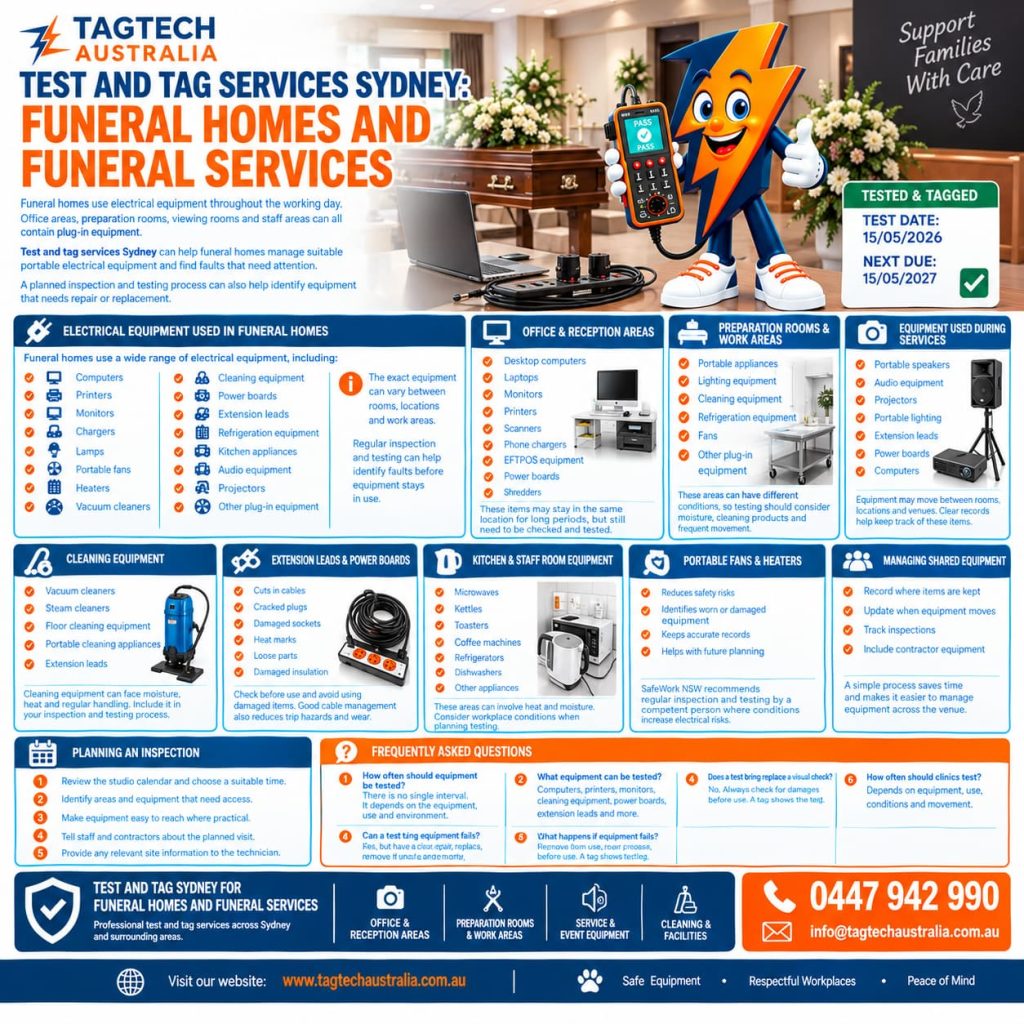
Funeral homes use electrical equipment throughout the working day. Office areas, preparation rooms, viewing rooms and staff areas can all contain plug-in equipment.
Some equipment also moves between rooms. Other items may face regular cleaning, handling or transport.
Therefore, test and tag services Sydney can help funeral homes manage suitable portable electrical equipment.
A planned inspection and testing process can also help identify equipment that needs repair or replacement.
Why Electrical Testing Matters in Funeral Homes
A funeral home can use many types of electrical equipment.
For example, equipment may include:
- Computers
- Printers
- Monitors
- Chargers
- Lamps
- Portable fans
- Heaters
- Vacuum cleaners
- Cleaning equipment
- Power boards
- Extension leads
- Refrigeration equipment
- Kitchen appliances
- Audio equipment
Furthermore, some equipment may move between rooms or work areas.
As a result, cables, plugs and equipment can receive repeated handling.
SafeWork NSW says plug-in electrical equipment should be regularly inspected and tested by a competent person when normal use exposes it to conditions that may cause damage or reduce its expected life.
Test and Tag Services Sydney for Funeral Home Offices
Funeral homes often have reception and administration areas.
These spaces can contain:
- Desktop computers
- Laptops
- Monitors
- Printers
- Scanners
- Phone chargers
- EFTPOS equipment
- Power boards
- Shredders
These items may stay in the same location for long periods.
However, daily use can still cause wear.
Therefore, suitable office equipment should form part of the business’s wider electrical equipment management process.
Preparation Rooms and Work Areas
Some funeral businesses have dedicated preparation areas.
These rooms can contain electrical equipment that needs careful management.
Depending on the business, equipment may include:
- Portable appliances
- Lighting equipment
- Cleaning equipment
- Refrigeration equipment
- Fans
- Other plug-in equipment
The conditions in these areas can also differ from a normal office.
For example, moisture, cleaning products or frequent equipment movement may increase wear.
Therefore, businesses should consider the actual conditions when planning inspection and testing.
Refrigeration Equipment
Some funeral facilities use refrigeration equipment as part of their operations.
These appliances can operate for long periods.
However, not every electrical item connected to a workplace will fall into the same testing process.
Businesses should consider suitable portable electrical equipment and follow the manufacturer’s requirements for larger or specialised equipment.
Where specialised electrical work or repairs are needed, an appropriately licensed electrical worker should carry out that work.
Cleaning Equipment
Cleaning is an important part of many funeral facilities.
Staff or contractors may use:
- Vacuum cleaners
- Steam cleaners
- Floor cleaning equipment
- Portable cleaning appliances
- Extension leads
- Other plug-in equipment
Cleaning work can expose electrical equipment to moisture and other conditions that may cause damage.
Therefore, staff should check equipment before use and remove damaged items from service.
Regular inspection and testing can also help identify electrical faults that a visual check may not detect.
Portable Fans and Heaters
Funeral homes may use portable fans or heaters in different areas.
These appliances can move from room to room.
As a result, they may experience repeated handling.
Businesses should check portable appliances for visible damage and include suitable equipment in their electrical inspection and testing process.
Lighting Equipment
Good lighting is important in reception areas, viewing rooms and other workplace areas.
Funeral homes may use:
- Portable lamps
- Floor lamps
- Display lighting
- Task lighting
- Portable lighting equipment
Staff should report damaged cords, plugs or equipment cases.
Fixed lighting installations are different from portable plug-in equipment. Electrical work or repairs on fixed installations should be handled by an appropriately licensed electrical worker.
Extension Leads and Power Boards
Some areas may require extra power connections.
For example, staff may use power boards for computers, chargers or other office equipment.
Therefore, extension leads and power boards should receive attention during inspections.
Look for:
- Cuts in cables
- Cracked plugs
- Damaged sockets
- Heat marks
- Loose parts
- Damaged insulation
If an item shows damage, staff should stop using it.
Kitchen and Staff Room Equipment
Funeral homes may also have staff kitchens or break areas.
These spaces can contain:
- Microwaves
- Kettles
- Toasters
- Coffee machines
- Refrigerators
- Dishwashers
- Other portable appliances
These appliances may experience regular use.
In addition, kitchens can involve moisture and heat.
Therefore, businesses should consider the workplace conditions when reviewing their electrical equipment testing needs.
Equipment Used During Funeral Services
Funeral services may involve equipment that moves between rooms or locations.
For example, a business may use:
- Portable speakers
- Audio equipment
- Projectors
- Portable lighting
- Extension leads
- Power boards
- Computers
This equipment may be packed, transported and set up repeatedly.
As a result, cables and plugs can experience extra wear.
Clear equipment records can help staff keep track of these items.
Equipment Taken to Other Locations
Some funeral businesses provide services away from their main premises.
Equipment may travel to:
- Places of worship
- Community venues
- Cemeteries
- Crematoriums
- Private venues
- Other locations
Portable equipment can face more movement when it travels.
Therefore, businesses should inspect equipment before use and include suitable portable items in their testing process.
What Happens When Equipment Fails?
If equipment fails an electrical test, staff should stop using it.
The business should then:
- Remove the equipment from service.
- Disconnect or isolate it where appropriate.
- Clearly identify the failed equipment.
- Arrange repair or replacement.
- Have repaired equipment checked before returning it to service.
SafeWork NSW advises that unsafe electrical equipment should be disconnected or isolated and should not return to use until it has been repaired and found safe, replaced or permanently removed.
This process helps prevent known faults from remaining in use.
Keeping Electrical Testing Records
Good records help funeral businesses manage their electrical equipment.
Records can include:
- Equipment details
- Tester name
- Testing date
- Test result
- Next test date
- Failed equipment
- Repair or replacement actions
SafeWork NSW says testing records should include the name of the tester, testing date, outcome and next testing date. The record may also be provided by a tag attached to tested equipment.
Therefore, clear records can help staff track equipment across different rooms and locations.
How Often Should a Funeral Home Arrange Testing?
There is no single testing interval that suits every funeral home.
Instead, the suitable approach depends on the equipment, workplace and conditions.
Businesses should consider:
- How often equipment moves
- How many people use it
- Where it operates
- Whether moisture or heat is present
- The amount of wear
- Previous equipment faults
- Whether equipment travels between locations
SafeWork NSW states that testing frequency varies according to the nature of the workplace and the risks linked to the electrical equipment.
Therefore, funeral businesses should review their testing needs when equipment or work practices change.
Planning Testing Around Funeral Services
Funeral homes often work around scheduled services and appointments.
Consequently, testing should cause as little disruption as possible.
A mobile service can make planning easier.
For example, businesses may arrange testing:
- Before opening
- After the business closes
- During quieter periods
- Between scheduled services
- During planned maintenance
This approach can help staff keep normal operations running.
Managing Shared Equipment
Some equipment may be shared between staff members.
For example:
- Portable speakers
- Chargers
- Power boards
- Extension leads
- Portable fans
- Cleaning equipment
Because several people may use the same equipment, clear records can help staff keep track of it.
As a result, shared equipment is less likely to be overlooked.
Equipment Used by Contractors
Funeral homes may also work with cleaners, venue staff, contractors and other service providers.
Some contractors may bring electrical equipment onto the premises.
Therefore, businesses should have clear arrangements for equipment brought into the workplace.
Where the business controls or manages equipment, it should consider whether that equipment forms part of its electrical safety process.
Clear communication can also help avoid confusion about equipment that has been tested.
Why Professional Testing Can Help Funeral Homes
Professional inspection and testing provides a structured way to manage suitable portable electrical equipment.
It can also help identify faults that may not be obvious during normal use.
Furthermore, clear records can make equipment management easier.
Standards Australia explains that AS/NZS 3760:2022 provides a structured approach to in-service inspection and testing of electrical equipment and RCDs. It also covers inspection, testing, documentation, tagging and competency.
Therefore, a suitable testing process can support a funeral home’s wider electrical safety management.
Test and Tag Services Sydney for Funeral Businesses
Funeral homes rely on electrical equipment for office work, cleaning, services and daily operations.
A damaged cable, faulty power board or unsafe appliance can create an avoidable workplace problem.
Therefore, businesses should keep suitable electrical equipment under regular review.
Test and tag services Sydney can help funeral homes manage suitable portable electrical equipment.
Tagtech Australia provides mobile test and tag services for businesses across Sydney.
Frequently Asked Questions
Do funeral homes need electrical equipment testing?
The need for inspection and testing depends on the equipment, workplace conditions and how the equipment is used. Businesses should assess their electrical equipment and workplace risks.
What equipment can be tested in a funeral home?
Suitable portable electrical equipment can include computers, printers, portable lighting, cleaning equipment, power boards, extension leads and other plug-in appliances.
Should portable speakers and audio equipment be tested?
Suitable plug-in audio equipment can form part of an electrical inspection and testing program, particularly where equipment moves between rooms or locations.
Should cleaning equipment be tested?
Suitable plug-in cleaning equipment can form part of the testing process. Cleaning equipment should also receive regular visual checks for damage.
What happens if equipment fails a test?
The equipment should be removed from use and isolated where appropriate. The business can then arrange repair, replacement or permanent removal.
How often should a funeral home arrange testing?
There is no single interval for every funeral home. The suitable approach depends on the equipment, workplace conditions and level of risk.
Can Tagtech Australia provide mobile testing?
Yes. Tagtech Australia provides mobile test and tag services for suitable portable electrical equipment at businesses across Sydney.
Experience, Expertise, Authority, and Trust
This guide explains how test and tag services Sydney can support funeral homes and funeral service businesses that use portable electrical equipment.
Tagtech Australia provides mobile test and tag services for businesses across Sydney. Our service focuses on practical electrical equipment testing, clear records and convenient on-site service.
Each business should review its own equipment, workplace conditions and electrical safety needs when planning inspections and testing.
Why Businesses Choose Tagtech Australia
✔ Reliable test and tag Sydney services
✔ Clear compliance tagging and digital reports
✔ Flexible scheduling across Sydney NSW
✔ Efficient and professional inspections
✔ Focus on practical workplace safety
We help businesses keep their equipment organised, tested, and safe.
📞 Call 0447 942 990
📧 Email info@tagtechaustralia.com.au
Outbound References (for compliance context)
SafeWork NSW – Electrical Inspection and Testing
SafeWork NSW electrical inspection and testing guidanceSafeWork NSW – Electrical Work
SafeWork NSW electrical safety guidanceStandards Australia – AS/NZS 3760:2022
Standards Australia AS/NZS 3760:2022 information
Experience, Expertise, Authority, and Trust
This guide explains how test and tag services Sydney can support funeral homes and funeral service businesses that use portable electrical equipment.
Tagtech Australia provides mobile test and tag services for businesses across Sydney. Our service focuses on practical electrical equipment testing, clear records and convenient on-site service.
Each business should review its own equipment, workplace conditions and electrical safety needs when planning inspections and testing.
.

